Dong-A Brand Guide: Who Makes the Best Gel Ink in Korea?
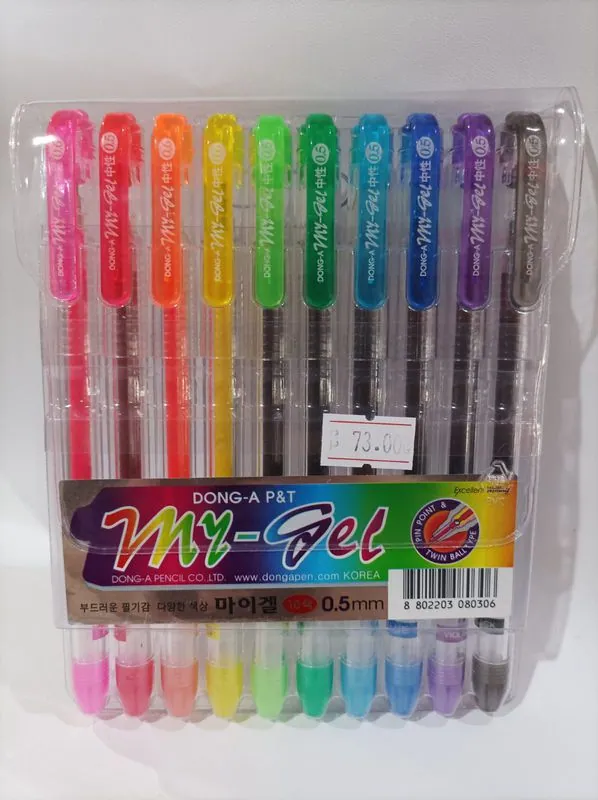
Monami gets the headlines, but Dong-A has been making Korean writing instruments for nearly as long. Their My Gel line has a devoted following among students and writers who find it writes differently from the competition. Here is the full picture.
Dong-A in Korean Writing History
Most conversations about Korean pens start with Monami, partly because the 153 has a genuinely remarkable cultural history and partly because Monami has done a better job of reaching Western markets. Dong-A, founded in 1946, pre-dates Monami's pen division and has its own decades-long presence in Korean classrooms and offices. The brand never became a crossover cultural symbol the way the 153 did, but among Korean students who pay attention to their pens, it is a known and trusted name.
The brand's positioning sits slightly above the mass market. Where Monami leans into affordability and volume, Dong-A positions its main lines around consistency and smooth ink delivery. Whether that distinction holds up against the actual products is worth examining.
The My Gel Line Explained
The My Gel is Dong-A's flagship gel pen and the product most frequently praised by people who discover the brand outside Korea. It comes in 0.38mm and 0.5mm variants — the 0.5mm being the one most people reach for — and uses a water-based gel ink that sits somewhere between Japanese needle-tip gel pens and the thicker-flowing Korean gel you find in the Monami FX range.
The standout characteristic is ink consistency. Over two pages, the line weight on a My Gel 0.5mm varies less than most comparable pens. There is no fat-start on the first stroke after the pen sits capped, and the ink does not dry out in the barrel quickly. Korean students who colour-code notes have historically trusted this line because the cap can stay off for an extended period without the tip drying.
The ink colour is a true blue-black rather than the slightly green-tinged "black" that some cheaper gel pens produce. For anyone writing by hand in a notebook they want to keep, that matters.
Fine Tech Fine-Liners for Bullet Journalers
The Fine Tech is Dong-A's answer to the Staedtler Pigment Liner and the Sakura Micron. It comes in several nib widths — 0.2mm, 0.3mm, 0.4mm, and 0.5mm — and uses a pigment-based ink that resists water and smearing. The needle-tipped nib writes cleanly on standard notebook paper without catching.
For bullet journalers, the Fine Tech is useful for two things: inking grid lines and writing the month headings that anchor a journal spread. The pigment ink layers without bleed on most 80gsm paper. On 70gsm or thinner, you will see some show-through, but that is true of virtually every fine liner on the market.
The 0.3mm is the most versatile width. The 0.2mm requires a light touch and struggles with textured paper. The 0.5mm is essentially a fine felt tip and loses the precision advantage of the thinner sizes.
UK Availability and Alternatives
Dong-A pens have limited but growing UK availability. Amazon UK lists the My Gel in 10-packs and the Fine Tech in multi-packs; availability fluctuates by month. CultPens has stocked Dong-A products intermittently. Unlike Monami, which has become common enough that some UK stationery shops carry it, Dong-A remains largely an online-only purchase in Britain.
The closest direct alternative in the UK for the My Gel is the Pentel EnerGel 0.5mm — similar gel flow, similar price bracket, much easier to find in Ryman or WHSmith. The Fine Tech competes with the Staedtler Triplus Fineliner and the Pigment Liner, both of which are easier to source. If continuity of supply matters to you, Dong-A is a first-choice for writers who will order online, a risky choice for anyone who needs to replace quickly at short notice.
Why Dong-A Gel Ink Feels Different
The main claim Dong-A fans make is that the My Gel ink feels "wetter" without being smeary — a combination that is harder to achieve than it sounds. Gel pens tend to either flow freely and smear (Uni Signo at higher temperatures) or flow consistently but feel slightly stiff (many Japanese gel pens at 0.38mm). The My Gel occupies an unusual middle position.
The explanation is partially in the ink formulation. Dong-A uses a different viscosity modifier ratio than most Japanese gel pens, resulting in ink that starts flowing with minimal nib pressure but sets faster than its flow rate suggests. This is not a marketed technical claim — it is a characteristic that writers notice through use and that shows up consistently in comparisons.
Whether this makes the My Gel better than a Pilot G2 or a Pentel EnerGel is a matter of preference. It is genuinely different, in a way that is worth finding out for yourself if you care about the feel of your everyday pen.
FAQ
**Is Dong-A the same brand as the Dong-A newspaper?** No. Dong-A Ilbo (the newspaper) and Dong-A Pencil (the stationery brand) share a name and Korean identity but are separate companies with no corporate relationship.
**Where can I buy Dong-A pens in the UK?** Amazon UK is the most reliable source. CultPens carries them intermittently. They are not available in major UK high street stationery chains.
**How does the My Gel compare to a Pilot G2?** Both are 0.5mm gel pens in the same general price range. The My Gel has a thinner grip section than the G2 and the ink flows slightly faster. The G2 refill system is more widely supported. Most people who try both find a preference — it is worth ordering a small pack to test before committing.
**Does Dong-A Fine Tech ink work over pencil or watercolour?** The pigment ink in the Fine Tech is waterproof once dry, which makes it compatible with light watercolour washes applied after inking. Do not apply wet media before the Fine Tech ink has dried fully.